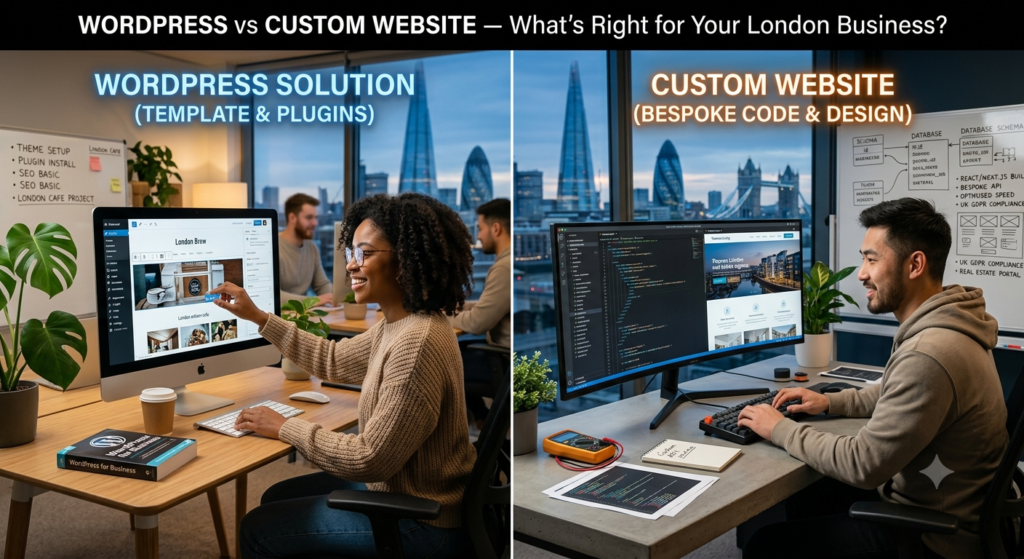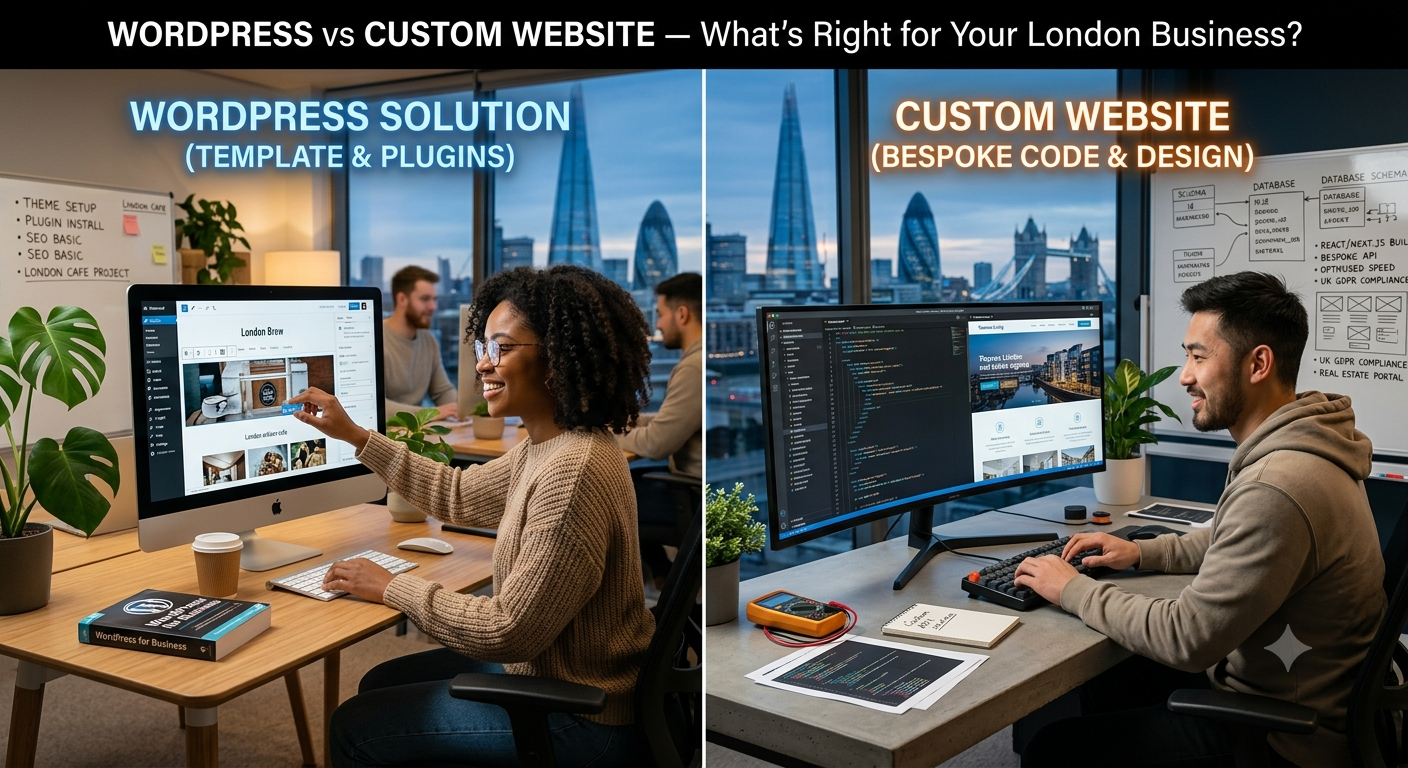
WordPress is ideal for London businesses that need a professional website quickly and affordably — typically £500–£2,000. A custom-built website offers complete flexibility, better performance, and unique functionality — starting from £2,000+. For most SMEs, WordPress is the smarter starting point. Custom is better for complex, unique requirements.
One of the most common questions we get from London business owners is: should I go with WordPress, or do I need a custom-built website?
It is a question that sounds simple but has a surprisingly nuanced answer. The truth is, both options can produce an outstanding result — but only when matched to the right situation. Choose the wrong one and you will either overspend on features you do not need, or underinvest and hit a wall when your business tries to grow.
This guide gives you a clear, honest breakdown so you can make the right choice for your specific business.
What is WordPress?
WordPress is the world's most popular content management system (CMS), powering over 43% of all websites globally. Originally a blogging platform, it has evolved into a flexible system capable of running everything from simple business websites to large eCommerce stores.
With WordPress, your developer uses a pre-built foundation — themes for design, plugins for functionality — and customises it to suit your brand and requirements. The core software is free. You pay for hosting, premium themes, plugins, and developer time.
Popular uses: Business websites, blogs, portfolios, news sites, WooCommerce stores
What is a Custom-Built Website?
A custom website is built entirely from scratch. Rather than using themes or plugins, developers write bespoke code — typically using frameworks like Laravel, React, or Next.js — tailored precisely to your requirements.
Nothing is off-the-shelf. Every feature, every interaction, every database query is designed specifically for your business.
Popular uses: Web applications, SaaS platforms, marketplaces, complex eCommerce, portals, systems with unique functionality
WordPress vs Custom Website: The Key Differences
1. Cost
WordPress: Generally more affordable, because developers work with existing themes and plugins rather than building from scratch. A professional WordPress site in London typically costs £500–£2,500.
Custom website: Higher development cost because everything is built from zero. Expect £2,000–£15,000+ depending on complexity.
Verdict: WordPress wins on upfront cost for straightforward projects. However, custom can be more cost-effective long-term if your WordPress site requires heavy plugin customisation, constant updates, and ongoing developer fixes.
2. Speed to Launch
WordPress: Fast. A basic WordPress site can be live in a matter of days. A professional multi-page site with custom design typically takes 2–4 weeks.
Custom website: Slower. Even simple custom builds take 4–8 weeks because everything is built from scratch. Complex projects take 3–6 months.
Verdict: WordPress is significantly faster to launch. If you need to get online quickly, it is the clear choice.
3. Design Flexibility
WordPress: Highly customisable within the theme framework. A skilled developer can make a WordPress site look completely unique. That said, there are limits — certain layouts and interactions are constrained by the theme structure.
Custom website: Unlimited design freedom. Every pixel, every animation, every user interaction can be exactly as you envision with no constraints.
Verdict: For most London businesses, WordPress provides more than enough design flexibility. Custom is better when design is a genuine competitive differentiator.
4. SEO Performance
WordPress: Excellent for SEO when set up correctly. With plugins like Yoast SEO or Rank Math, you can manage meta tags, sitemaps, schema, and page speed effectively. The vast majority of ranking websites use WordPress.
Custom website: Can be built to be extremely lean and fast — no plugin bloat, no unnecessary code. This can give a slight technical SEO advantage, though in practice the difference is rarely the deciding factor.
Verdict: Both can rank well on Google. SEO success depends far more on strategy, content, and backlinks than on the platform. WordPress with proper SEO setup is more than capable.
5. Ease of Management
WordPress: You can update content, add blog posts, change images, and manage products yourself — without touching code. The admin dashboard is intuitive enough for non-technical users.
Custom website: Without a CMS built in, content updates often require a developer. Some custom builds include a custom admin panel, but this adds to the development cost.
Verdict: WordPress is far easier for day-to-day management if you want control over your own content.
6. Security
WordPress: Because it powers 43% of the web, it is also the most targeted platform by hackers. However, proper security practices — strong passwords, regular updates, security plugins, reliable hosting — make a WordPress site very secure.
Custom website: Custom code is less of a target because attackers cannot exploit known WordPress vulnerabilities. However, poor custom code can introduce its own security risks.
Verdict: Both are secure when properly maintained. WordPress requires more active security management (updates, plugin monitoring). Custom requires careful code review.
7. Scalability
WordPress: Scales well for most business needs — from a 5-page site to a 500-page website with thousands of products. Very high-traffic sites (millions of visits/month) may need specialist WordPress hosting and optimisation.
Custom website: Built specifically for your growth path. If your business has complex, unique scaling requirements — like a marketplace with thousands of vendors or a SaaS product with advanced user management — custom is the better foundation.
Verdict: WordPress handles most London SME growth comfortably. Custom is the right choice when your business model has genuinely unique technical scaling needs.
Real-World Scenarios: What Should You Choose?
Scenario 1: Local London Service Business (Plumber, Accountant, Salon)
You need a professional 5–10 page website to generate local enquiries, rank on Google, and look credible. → WordPress is ideal. Fast, affordable, easy to update.
Scenario 2: London eCommerce Store
You want to sell products online with a smooth checkout, product management, and order tracking. → WordPress with WooCommerce (or Shopify) is ideal for most stores. Custom eCommerce makes sense only if you have very specific or complex product logic.
Scenario 3: SaaS Platform or Web Application
You are building a tool that users log into, with dashboards, data processing, and complex user management. → Custom is essential. WordPress is not built for application logic at this level.
Scenario 4: Corporate Website with Complex CMS Needs
Large business with multiple content editors, workflow approvals, and deep integration with internal systems. → Custom or a headless CMS solution is often better at this scale.
Scenario 5: Startup Launching Fast
You need to validate your idea online within weeks without a large upfront investment. → WordPress first. You can always migrate to a custom platform once you have traction and funding.
The Hidden Costs — What Nobody Tells You
Many London business owners compare only the build cost. That is a mistake. The true cost of a website is what you spend over 3 years, not just at launch.
WordPress ongoing costs to consider:
- Hosting: £10–£50/month
- Premium plugins: £100–£500/year
- Security updates and maintenance: £50–£200/month
- Developer fees for plugin conflicts or updates: Variable
Custom website ongoing costs:
- Server/hosting: £20–£200/month
- Developer maintenance for bug fixes and updates: Variable
- No plugin ecosystem — every new feature requires custom development
The honest conclusion: WordPress can become expensive if you keep adding plugins and customisations over time. Custom can be cost-efficient long-term if your requirements are stable and your team manages it well.
What Does WebBuilderLTD Recommend?
At WebBuilderLTD, we build both — and we always recommend what is right for your business, not what is easiest for us to sell.
For the majority of London SMEs, WordPress is the smarter choice — it is affordable, fast to launch, easy to manage, and more than capable of ranking on Google when built correctly.
For businesses with complex, unique, or application-level requirements, custom development delivers the freedom and performance that WordPress cannot match.
We offer both WordPress and custom web development from our London base — with packages starting from £249 and a 100% money-back guarantee.
Talk to us for free — we'll tell you honestly which is right for you
Quick Decision Summary
| Your Situation | Choose |
|---|---|
| Need a site fast and affordably | WordPress |
| Non-technical — want easy content management | WordPress |
| Standard business, service, or portfolio site | WordPress |
| eCommerce with standard products | WordPress + WooCommerce |
| SaaS or web application | Custom |
| Marketplace or complex user portals | Custom |
| Unique business logic with no plugin equivalent | Custom |
| Long-term unique brand differentiation | Custom |
Frequently Asked Questions
Q: Is WordPress or a custom website better for SEO in London?
A: Both can rank well. WordPress with proper SEO setup (Yoast or Rank Math, fast hosting, clean structure) is more than capable of ranking on Google. Custom websites can have a slight speed advantage but the difference is rarely significant for most businesses.
Q: How much does a WordPress website cost in London?
A: A professional WordPress website in London costs between £500 and £2,500 for most businesses. WebBuilderLTD offers WordPress websites from £545 with mobile-responsive design and SEO-friendly structure.
Q: How much does a custom website cost in London?
A: Custom websites in London start from around £2,000 for simple builds and go up to £15,000+ for complex applications or platforms.
Q: Can I switch from WordPress to a custom website later?
A: Yes, but it involves a full rebuild rather than a migration. It is worth planning ahead — if you know your requirements will outgrow WordPress within 2–3 years, starting custom may save money long-term.
Q: Is WordPress secure enough for a London business website?
A: Yes, with proper setup. Use a reputable host, keep WordPress and plugins updated, use a security plugin, and enable two-factor authentication. WebBuilderLTD builds all WordPress sites with security best practices in place.
Q: How long does it take to build a WordPress website in London?
A: A basic WordPress site can be live in 48–72 hours. A professional multi-page site typically takes 2–4 weeks with WebBuilderLTD.